


(After Greece, the history of the Mediterranean shifts to Rome. However, in between, we have the conquest of Alexander the Great. Often, this event is portrayed as an advanced European civilization sweeping in to civilize a backward East, but let’s examine what the situation was really like.
IIncidentally, it must be noted that his power was largely sustained by the vast quantities of gold that Macedonia once produced. Backed by this wealth, Macedonia maintained a large standing army, much like the European nations after the 17th century.)
Did Alexander the Great Conquer the East, or Was He Conquered?
.
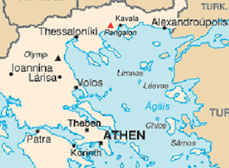
Macedonia, Alexander’s homeland, was part of the Greek civilization in terms of ethnicity and language, but it was a latecomer within that sphere. Macedonia was a poor region, divided into powerful clans. It was Philip II, who reigned from 359 to 336 BC, who transformed Macedonia into a strong country. Philip developed a gold mine at Pangaion, which produced an amount of gold equivalent to 30,000 metric tons of silver,worth about $23 billion in today’s terms, or around one-tenth of modern Greece’s annual GDP.
.
.
This fortune allowed him to expand trade, strengthen his army, and centralize his rule. Unlike Athens, which relied on citizen soldiers, Macedonia had a standing army. Camaraderie between the king and his soldiers was emphasized, and in theory, the people’s assembly chose the king’s successor.
.
Riding on his father’s achievements, Alexander set out to conquer the East, including Greece. According to Arrian’s ‘The Anabasis of Alexander’, written during the Roman period, Alexander’s motives remain unclear. He may have been driven by a desire to avenge Greece’s past conflicts with Persia and by a boundless ambition to reach the fabled “Pacific Ocean.” Around 50,000 soldiers were mobilized, with a core of cavalry, making it a formidable standing force. All of this owes to the Pangaion gold mine.
.
Almost all cities on the Greek mainland were forced to submit to Alexander, but when he marched further east, some Greeks felt relieved to be rid of him. Although tutored by Aristotle, Alexander’s view of the world was somewhat primitive. He revered Athens as the pinnacle of Greek civilization, yet sometimes regarded Egypt as Greece’s cultural origin. While he used propaganda to frame Greece as a land of “freedom” and Persia as a land of “despotism and servitude,” he also had a superstitious side, often relying on prophecies when making decisions.
.
Alexander promoted “freedom” and even brought his court sculptor with him to Asia, preserving Hellenistic style for posterity. However, he was also heavily influenced by Persian culture. He married a Persian princess, adopted the title Iskander (monarch) in Persian, and wore Persian-style clothing. The name Iskander remains in use across Eurasia today, appearing in Russian names and in the name of a Russian short-range missile system deployed in places like Belarus.
.
Was Alexander genuinely fascinated by Persian civilization, or was he simply trying to win over the people of the East? It appears to have been the former. As his army advanced eastward, the soldiers’ anxiety and discontent grew, but so did Alexander’s authoritarian tendencies. In a tragic incident, he killed his close friend Cleitus in a fit of rage, which he deeply regretted.
.
Nonetheless, his system for governing conquered territories largely preserved the Persian model of centralized rule. Greek officials held top positions, but Persian bureaucrats continued administering the territories much as before. This arrangement likely helped Alexander maintain a stable retreat route even as he pushed further east. In a despotic system, the bureaucrats tend to support whoever holds power at the top.
Leave a Reply