


(The source text of this series is “In Search of Lost Modernity” by Akio KAWATO.
The English edition of this book (originally written in Japanese) is on
https://docs.google.com/document/d/1hiRK7kjbX0Hxd2NOxPqtQlVWgjDHgKCr/edit
https://docs.google.com/document/d/1MB0Me9P5Lpa2HGceuJUdMqqQ2CRHQSxa/edit
The copyright belongs to the author, Akio Kawato
.
(This installment points out that little is known about how politics and the economy in the Mediterranean region unfolded during the 1,000 years leading up to the rise of ancient Greek civilization, as epitomized by Athens.
This period also spans the 1,000 years following the legendary Trojan War and the invasions by the “Sea Peoples” during that same era.
Because we do not fully understand what happened during these 1,000 years, the relationship between ancient Greek civilization and the civilizations of the Orient remains vague and unclear.)
.
Greco-Roman Civilization
.
Before Greece
In the history we learned in school, we’re often told, “After Egypt and Mesopotamia, the Greek city-states suddenly emerged, and democracy blossomed in Athens.” However, if we look closer, there’s actually a gap of more than a thousand years between these civilizations. So, the truth is that while Egypt and Mesopotamia continued for centuries without major changes, the Greek city-states eventually rose to prominence, challenging the existing order.
.
Greek city-states, in fact, date back to as early as the 16th century BC, in areas like Mycenae, Troy, and Crete. The Minoan civilization on Crete, thought to have developed around 3000 BC, engaged in trade and conflict with contemporary powers in Egypt, Syria, and Turkey. Other influential cultures outside of Egypt and Mesopotamia included the Hittites, Mitanni, Cypriots, Canaanites, Minoans, and Mycenaeans, all contributing to the region’s dynamic history.
.
One of the most intriguing events in Mediterranean history occurred around 1177 BC, when a mysterious group known as the “Sea Peoples” attacked cities across the area, in some cases causing significant destruction. Egypt managed to repel the Sea Peoples, while Mesopotamia appeared relatively unaffected. But in Greece, this invasion plunged the region into chaos and left a historical void lasting almost 500 years. After the “People of the Sea,” the Greek region experienced a decline in terms of the scale of its architecture and the quality of its crafts..
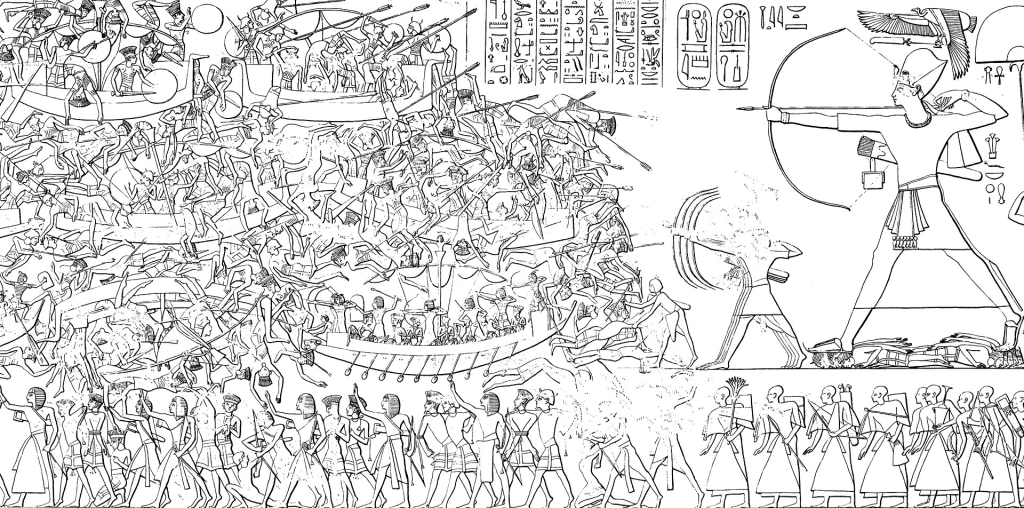
( Egyptian campaign against the Sea Peoples)
.
For many years, a popular theory among European scholars proposed that around 1100 BC, a group called the Dorians—a northern people with fair skin who were thought to be democratic and intellectually advanced—migrated to Greece and founded prominent city-states like Sparta. This supposedly ended the “dark age” in Greece.
.
However, this theory oversimplifies a complex history. While the Dorians likely migrated into Greece, it doesn’t mean they introduced an “advanced” civilization. People from the Indo-European language family, often classified as “white,” had already settled in Greece by around 2200 BC, so the Dorian arrival around 1100 BC did not represent a complete cultural reset.
And even during this “lost” period in Greece, Egypt and Mesopotamia continued to evolve, and it’s known that the language spoken in Greece before the Sea Peoples’ arrival remained in use afterward.
.
Greece has poor, mountainous soil and was never a particularly wealthy region to begin with. Scholarship, too, did not suddenly emerge in Greece. Later Europeans concocted a “romanticized view of civilization,” positing that “civilization evolved from Greece to Rome to post-Renaissance Western Europe.” In reality, Western European civilization is also a derivative of the civilization in the Orient.
.
Nevertheless, as I will discuss later, post-Renaissance Western European civilization was built upon the foundation of the “individual”—a person with a well-defined sense of self—a characteristic not found in modern Islamic regional civilizations. And its origins may lie in the civilization of ancient Athens.
Leave a Reply