


(King Charles of the United Kingdom is currently on a state visit to the Caribbean. There, he has expressed remorse for the country’s past—specifically, the fact that, beginning in the 17th century, Britain brought large numbers of African slaves to work on sugarcane plantations, using their labor as the foundation for its own economic development.
Before debating ethical issues, let’s first establish the facts. It should also be noted that Britain was not the only country in history to engage in the slave trade. In the Middle Ages, it appears that white Westerners were sometimes traded as slaves by Venetian and Islamic merchants.
.
The source text is “In Search of Lost Modernity” by Akio KAWATO.
The English edition of this book 〔originally written in Japanese〕 is on
https://docs.google.com/document/d/1hiRK7kjbX0Hxd2NOxPqtQlVWgjDHgKCr/edit
https://docs.google.com/document/d/1MB0Me9P5Lpa2HGceuJUdMqqQ2CRHQSxa/edit)
(The copyright belongs to the author, Akio Kawato))
.
The Caribbean Islands: Sugar Cane and British Wealth
.
In 1627, Britain established a colony in Barbados, which had been devastated by Spanish and Portuguese forces, leading to the extinction of the indigenous population. English settlers displaced by the conflict between Royalists and Parliamentarians during the English Civil War migrated there. In 1655, the British Navy under Oliver Cromwell seized Jamaica, establishing it as a base for controlling the Caribbean. By 1670, Britain had also taken control of the Cayman Islands.
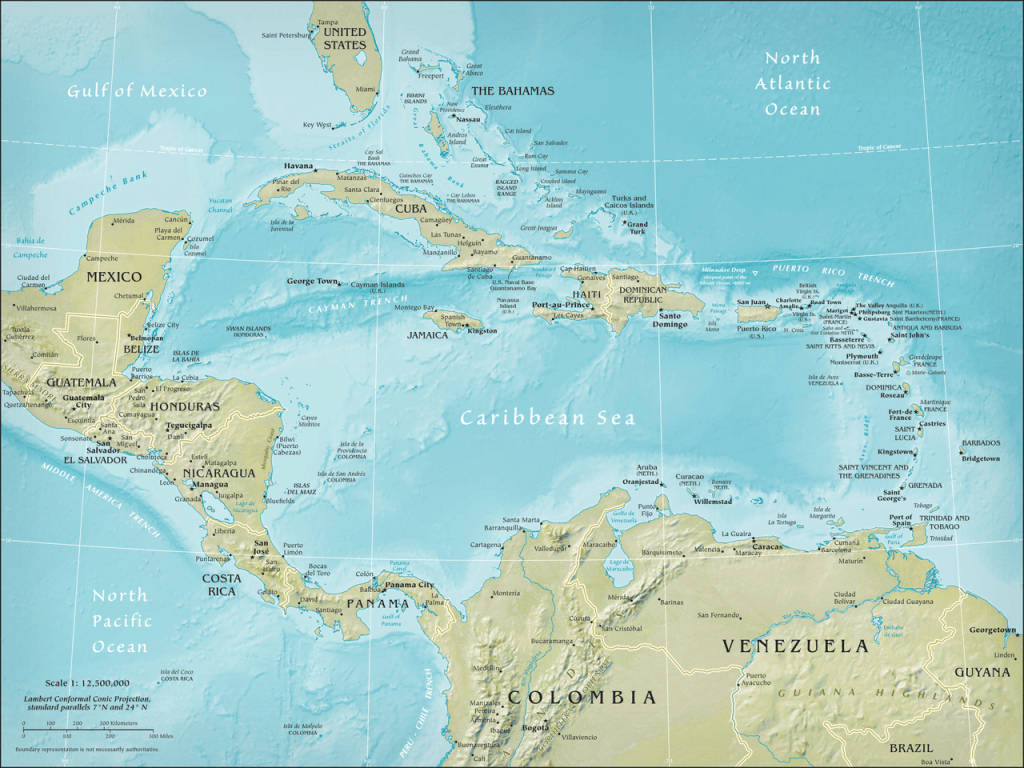
Earlier, in the 1650s, Dutch plantation owners expelled from northeastern Brazil introduced sugarcane cultivation—originally from the Madeira Islands—to Barbados, setting up the Caribbean’s first sugar plantations. At first, Irish laborers were used, followed by enslaved Africans.
.
The raw sugar produced in the Caribbean was refined in Britain and consumed domestically or exported to the European continent. Rum made from sugar was also used in the transatlantic slave trade to purchase African captives. In Jamaica, planters imported meat and flour from Britain and the North American colonies—despite these being more expensive than the ones which French Caribbean territories imported—and still managed to make profits of 8–10%.
.
Britain further profited through shipping and insurance services related to Jamaican trade. By 1773, profits from Jamaica alone were estimated at nearly £1.5 million. Assuming one pound equaled 8.35 grams of gold at the time, and using a modern gold price of $110 thousand per kilogram, this would amount to about $700 million today.
.
According to Wikipedia, trade between Britain and its Caribbean territories, such as Jamaica, was nearly equal in volume to that with British North America. While imports and exports were roughly balanced, both routes were profitable for British merchants. Early export destinations for British-manufactured cotton textiles included Africa and the Caribbean, while North American colonies exported grain, timber, and rum to the Caribbean and used the proceeds to import British goods. Under the Navigation Act of 1651, only British ships could carry goods between colonies and Britain, securing enormous profits for British shipping firms.
.
The close economic and political ties that remain today between Britain and territories like Jamaica, the Bahamas, and the Cayman Islands have their roots in this colonial history. It can be said that Caribbean sugarcane helped finance the British Industrial Revolution.
.
The Slave Trade
.
Following Spain and Portugal, the Netherlands, Britain, and France all embraced the colonial model of using African slaves on large plantations to generate profits. This practice fueled the development of sugarcane plantations in the Caribbean and cotton and tobacco farming in North America. At first, sugar was shipped to Britain for processing, later followed by cotton. Profits from exporting these goods around Europe and the wider world helped finance the Industrial Revolution.
.
Slave traders from cities like Liverpool and Bristol are also recorded as having invested their profits into emerging industries in the 19th century. As mentioned earlier in this book, while capital from within Western Europe—such as that from Mediterranean cities—played a major role in Europe’s economic rise, there is no doubt that the profits from slavery and the exploitation of enslaved people contributed significantly to the capital that fueled Britain’s Industrial Revolution.
.
Mechanism of the Slave Trade
.
The European “business” of enslaving large numbers of Africans began in 1442, when Prince Henry the Navigator of Portugal captured Berbers. Portugal alone is estimated to have transported about four million Africans to its colony of Brazil. In 1502, Spain began importing African slaves to make up for labor shortages in South America. There are various estimates as to how many African blacks were taken as slaves by white Europeans, but the average annual figure was fifty to sixty thousand.
.
It is important to note that Africans were not enslaved because they were “backward.” They were often sold into slavery by the kings of local African states. According to “1492: The Year the World Began” by Felipe Fernandez-Armesto, medieval Africa had powerful empires like Mali, which exported gold to Europe, and 12th-century Ghana, where kings lived in palaces adorned with artworks and glass windows, wore silk garments, and accumulated gold bars. In Kumbi Saleh, believed to have been Ghana’s capital (in present-day Mauritania), excavations have revealed a town covering about 1.5 square miles, built in the 10th century with grid-patterned streets and multi-story buildings that may have housed about 20,000 people.
.
It is likely that African kings sold war captives or those who failed to pay tribute to European traders. In the late 17th century, the British Royal African Company purchased slaves from the Dahomey Kingdom (now Benin), whose rulers conducted slave raids and waged tribal wars to capture prisoners.
.
Magnitude of the Slave Trade
.
The business of buying slaves in Africa and selling them in the Caribbean and the Americas was enormously profitable, often yielding profits of over 100%. Nearly all major European powers were involved. Between 1501 and 1866, about 12.5 million Africans were forcibly taken from their continent.
.
Of these, approximately: 6 million were enslaved by Portugal and the Netherlands, 3.26 million by Britain, 1.38 million by France, 1.06 million by Spain and Uruguay, 0.3 million by the United States, and 0.11 million by Denmark.
By around 1650, the Netherlands had overtaken Spain and Portugal to become the leading maritime trader, including in the slave trade. It’s estimated that the Netherlands transported around 0.55 million slaves, of whom 75 thousand died at sea and were thrown overboard. Moreover, many slaves sold to Spain and France were transported by Dutch ships.
.
England entered the slave trade in 1562, when John Hawkins, a pirate who later became a naval admiral, led a voyage to Africa. However, it wasn’t until the 17th century—after Britain had established colonies in the Caribbean and adopted the Spanish model of large-scale sugarcane plantations—that the slave trade became a major industry. From 1663 to 1698, the Royal African Company, granted a royal charter by the king, held a monopoly over the trade.
.
By 1698, Britain had become the world’s largest slave-trading nation, with Jamaica as a key destination for enslaved Africans. Although today we often associate black slavery with plantations in the American South, at the time, far more enslaved Africans worked in the Caribbean, and sugar plantations there generated huge profits for Britain.
.
As mentioned earlier, after winning the War of the Spanish Succession, Britain additionally secured the exclusive right (known as the asiento) to supply slaves to Spain’s colonies in South America under the Treaty of Utrecht in 1713.
.
The Slave Trade and the Economic Development of Western Europe
.
The European transatlantic slave trade, which involved the forced migration of an estimated 10 to 12 million Africans had a profound impact on the economic development of Western Europe.
.
Around 1730, a merchant from Bristol transported 270 slaves and made a profit of 7,000 to 8,000 pounds in gold at the time. At that time, one pound contained about 6.7 grams of gold. This is equivalent to about 700 dollars at the current price as of July 2025. .
.
Therefore, each slave would yield a profit of about 20 thousand dollars. If the UK traded 3 million African slaves from 1700 to 1866, when the slave trade was banned, the total profit would be roughly 60 billion US dollars. This makes 360 million dollars per year in average, which is equivalent to 1.5% of the British GDP around 1750, a significant amount.
.
The economic impact extended beyond direct profits. The sugarcane and cotton produced by slave labor generated even greater wealth. In 1798, British Prime Minister William Pitt estimated that tax revenue from large Caribbean plantations alone brought in four million pounds annually, with an additional one million pounds coming from other colonies. At that time, the British government’s entire annual budget was about 30 million pounds: colonial revenues were crucial to Britain’s finances.
.
Dr. Eric Williams—later prime minister of Trinidad and Tobago after its independence from Britain in 1956—made a powerful argument in his book “Capitalism and Slavery”. While he acknowledged that the slave trade did not provide all the capital needed for the Industrial Revolution, he wrote:
.
–“The profits flowing into England became one of the main sources of capital accumulation to meet the capital needs of the Industrial Revolution. The Caribbean islands became the center of the British Empire and came to have immeasurable significance for the greatness and prosperity of England. The British Empire was a grand superstructure of naval power built on the foundation of trade with America (based on Black labor), with a large proportion of that trade coming from the Caribbean islands.”–
.
The Sugar Revolution
.
Today, it is largely forgotten, but in the late 17th century, people spoke of a “Sugar Revolution.” Sugar was once a vital and extremely expensive commodity. Britain, the Netherlands, and France occupied the Caribbean islands—where the indigenous populations had been nearly wiped out—and brought in African slaves to cultivate sugarcane. This trade generated enormous profits. The sugar produced by enslaved Africans was shipped to Europe for refining and sale, bringing in immense wealth.
.
The system peaked around 1680. To put this growth into perspective, in the 15th century, Cyprus—then one of Europe’s major sugar-producing regions—produced about 50,000 tons of sugar annually. By the 18th century, the Caribbean islands, especially Dominica, were producing about 70,000 tons a year. By 1800, Britain’s annual sugar consumption had soared to 150,000 tons, fifteen times the level in 1700. If sugar today sells for about $17 per kilogram, the 150,000 tons consumed back then would be worth roughly $2.6 billion in today’s money.
.
In the 17th century, Caribbean islands like Jamaica and the Bahamas held a crucial position in British trade. In 1697, imports from the Caribbean made up 9% of Britain’s total imports, surpassing the 8% from the North American colonies. In total trade, the Caribbean accounted for 7%, compared to North America’s 6%. Even between 1714 and 1773, one-fifth of Britain’s total imports came from the Caribbean (including goods from other countries’ colonies), while one-ninth came from North America. On the export side, 6% of British exports went to the Caribbean and 9% to North America. As the white population grew in North America, imports from Britain increased, and by the 1770s, 20% of British exports were headed for the North American colonies.
.
Trade with Africa, by contrast, made up only a small share. Between 1714 and 1773, it accounted for just 0.5% of Britain’s total imports and 2% of its exports. However, since much of the Caribbean and North American trade involved transporting enslaved Africans and exporting slave-produced goods to Europe, Africa’s role in the broader “triangular trade” was highly significant.
.
In short, the Caribbean islands—and especially the sugarcane cultivated by enslaved Africans—played a vital role in Britain’s trade from the 17th to 18th centuries. They helped fuel the capital investment needed for the Industrial Revolution, increased British incomes, boosted consumption, and ultimately helped propel industrial development even further.
.
One important question arises: why didn’t the Netherlands, despite dominating global shipping in the 17th century, develop its own triangular trade and trigger an Industrial Revolution? Even though Dutch wind-powered industries thrived in the 16th century, the Industrial Revolution happened in Britain, not the Netherlands.
I’ll explore this question later—and the same issue applies to France.
.
It’s also important to note that Britain’s wealth did not rely solely on the triangular trade. Trade with other European countries remained even more significant. However, because many European industrial goods were based on materials from Asia and Latin America, it’s difficult to completely separate their growth from the profits of colonial trade.
Leave a Reply